Showing posts with label africa. Show all posts

Friday, 25 February 2011

Fleeing by land and by sea


Fleeing Guilin by the North Station, print by Cai Dizhi, 1945.

From the book art blog, A Journey Round My Skull.


Navio de emigrantes (Ship of Emigrants), painting by Lasar Segall, 1939.

From the art blog Weimar.


La notte di San Lorenzo (The Night of the Shooting Stars), a film by Paolo and Vittorio Taviani, 1982.

We watched this film last night, and the mirroring of what’s happening now in Libya was almost too painful to bear.

The dictator’s loss of power is now a certainty, so every killing by his forces in these days is a murder to no end, but still it goes on.

Make note of who still supports him, and by this know them well.
_

PRI’s The World produced a series of reports on migration last year centering on the story of one Somalian man fleeing war. Read and listen here, and learn how Gaddafi's thugs went about preventing migrants from reaching the EU.

Friday, 4 February 2011

“Greetings from the center of the world.”

So begins The Tahrir Show, a post by Blake Hounshell, managing editor of Foreign Policy magazine, on arriving in Cairo.

I’m too overwhelmed by it all today to pick out many individual items. Bob has a good set of links, and kindly points to my twitterings, but if you want to keep up don’t follow me on Twitter, follow some of the people I follow.

This exchange between David Brooks and Gail Collins at The New York Times site lays out an optimistic view on wider implications for the Middle East, and it’s an optimism I share for what that’s worth.

But the Middle East is not the only context. Tunisia and Egypt are African countries. From an editorial in South Africa’s Mail & Guardian:
. . . the tinder was stacked dry and ready for decades in Egypt. The levels of poverty, frustration and repression are if anything higher further south. Is it too much to hope that Africans choose to treat the Egyptian and Tunisian protests, with all their peril and potential, as our own?
More, via Al Jazeera live blog.

As usual, in depth live blogging by EA WorldView, The New York Times, and The Guardian, along with live coverage from BBC News and Al Jazeera, provides more detail than I can keep up with.

Thursday, 9 December 2010

Daytime listening

Jeb Sharp of PRI’s The World talks to political scientist Severine Autesserre about reasons for failure in peacemaking efforts in The Democratic Republic of Congo: The Trouble with the Congo. Her main argument is that national and international peacemaking efforts miss the importance of local causes of conflict. Part of the How We Got Here podcast series.

A two part documentary by Wendy Robbins on BBC World Service: The Holocaust Deniers, via Greens Engage. Also as MP3s, here and here.

Available for seven days only, Liu Xiaobo: ‘I Have No Enemies’ from BBC Radio 4.

Tuesday, 20 July 2010

World Service


Here’s some random viewing, listening and reading from the last week or so.

Above: The Ducor Hotel, Monrovia, Liberia. Photographs by Glenna Gordon, words by Jason Margolis, from Rebuilding Liberia, a series of reports on post war reconstruction broadcast by PRI’s The World.

In The Walrus: Where Ghana Went Right, by John Schram.

On the BBC World Service: something I missed when it was broadcast last March, Najieh Ghulami on Afghan Bloggers.

Related to that, something I haven’t listened to yet, Blogs & Bullets: Evaluating the Impact of New Media on Conflict, at the United States Institute of Peace, spotted via Onnik Krikorian’s blog at Frontline. (Reminds me of this!)

Thursday, 15 October 2009

Pilger links

Reading this, I felt it necessary to gather together links on a few John Pilger stories that had stuck in the mind over the years:

Martin Shaw, Research Professor of International Relations at the University of Sussex, on Pilger's downplaying of Saddam Hussein's responsibility in the suffering of the Iraqi people.

BBC special correspondent John Sweeney on the same topic.

Historian Marko Attila Hoare on Pilger's denial of genocide in Kosovo.

Martin Shaw on the same topic. (Also here.)

Ian Black, diplomatic editor of The Guardian, writing on Pilger's conspiracy theories about NATO action in Kosovo in 1999. The column by Pilger that he was responding to is here.

Pilger's support for those deliberately targeting civilians in Iraq.

Pilger's defence of the deliberate targeting of civilians in Israel.

Added, Pilger misrepresents the views of Independent Jewish Voices. (Thanks to Flesh is Grass.)

Added, 1 March 2010, Oliver Kamm on John Pilger’s approval of Gilad Atzmon:
“I’d like to know - and I invite him to comment on it - why Pilger is citing this bigot as a voice of conscience and an advocate of justice.”
More on Pilger and Atzmon at Engage and the CST blog.

Added, 10 June 2010, Michael Ezra takes on just one paragraph from  Pilger’s latest cornucopia of conspiracy theory. This is on the Vietnam War, though the Pilger New Statesman piece it comes from, The way to lie about another war, also raves on about Israel, North Korea, Iraq, Iran, Japan, and Oxbridge, all sites of “master illusions” and “black propaganda”. Oh yes, the quotation marks come thick and heavy in this piece of “journalism”. See also Mick Harley’s comments.

Another collection of Pilger links can be found on David Thompson’s blog, including one to a post by Tim Blair in 2004 reproducing Pilger’s declarations that American, British and Australian soldiers in Iraq were “legitimate targets”, and that:
“I think the situation in Iraq is so dire that unless the United States is defeated there that we’re likely to see an attack on Iran, we’re likely to see an attack on North Korea and all the way down the road it could be even an attack on China within a decade.”

Oliver Kamm collected criticisms of Pilger’s documentaries on Cambodia and on nuclear weapons in his 2006 post, Celebrating John Pilger.

Added, 19 December 2010, lawyer David Allen Green provides a legal commentary on Pilger on Assange. (Via Shiraz Socialist.)

Added, 5 June 2011, Denying Rwanda: An Open Letter to John Pilger, by Adam Jones PhD, author of Genocide: A Comprehensive Introduction, Routledge/Taylor & Francis Publishers 2010. (Via Max Dunbar.)

Added, 16 September 2011, Decline and Fall, Peter Ryley on Pilger and Libya.

Added, 30 October 2011, “Most egregious” competition, Gene of Harry’s Place compares comments by right wing radio commentator Rush Limbaugh, Republican congresswoman Michele Bachmann, and John Pilger, on the Obama administration’s intervention against the Lord’s Resistance Army in Uganda.

A commenter responding to that post helpfully links to a 2008 article by Sunny Hundal, The racist flip side of anti-imperialism, which begins:
What do Ralph Nader, John Pilger and Ayman al-Zawahiri have in common?

Before Barack Obama has even taken office or signed a single bill, all three have dismissed him as a sellout by using racial slurs. One might be tempted to say, “at least give the guy a chance,” but that would be a futile exercise.

The activist Ralph Nader and documentary filmmaker John Pilger both referred to him as an “Uncle Tom”, while, more recently, al-Qaida No 2 al-Zawahiri said Obama was “the direct opposite of honorable black Americans” like Malcolm X, and lumped Obama together with Condoleezza Rice and Colin Powell as “house slaves”.
The Pilger column referred to is here.

Saturday, 25 April 2009

Eastern Approaches

Above, Walden Books on Harmood Street, Camden, London, yesterday afternoon. This was a quick acrylic sketch, reworked a bit after I got home.

Below, a book I picked up there a couple of months ago, Eastern Approaches by Fitzroy Maclean. I’d never heard of him before reading this.

The book describes his time as a British diplomat in the USSR in 1937 and ’38, when he was in his mid-20s, and goes on to tell of his experiences with the SAS in the Second World War in North Africa, Persia and Yugoslavia.

While in the Soviet Union he spent his periods of leave on unofficial travel to Azerbaijan, Georgia, Uzbekistan, and on to Afghanistan by rail, road and foot, often with an escort of disgruntled NKVD men under orders to keep up with him. This section of the book also includes his vivid eyewitness description of one of Stalin’s show trials.

The middle part is made up of desert adventures behind enemy lines in North Africa, having escaped the diplomatic service by unusual means. He had previously tried to resign in order to join up, but was refused permission to leave. Reading the Foreign Office Regulations, he spied a way out: entering politics would disqualify him from the diplomatic service. He announced his intentions to the FO, resigned, joined up, ran for parliament, and then spent the rest of the war fighting overseas.

The final part of the book is about the last years of the Second World War in Yugoslavia, where he was Churchill’s ambassador to Tito’s Partisans. He gives some gruesome details of the extreme brutality of the war there, and of the divisions which were to re-emerge in the more recent Balkan wars. There is also explanation of the reasons for supporting Tito and the Communists over the Četnics, and of his own part in the decision.

I see Marko has written a much fuller account of this period, though as a casual reader I wonder how much more detail I’d have the stomach for.

Added - a curious consequence of Tito’s postwar break with Stalin here, via Oscar.

Wednesday, 7 January 2009

Tyrannicide

Further to my earlier post, there’s currently a discussion of the problems of tyrannicide on Lester Hunt’s blog.

Sunday, 28 December 2008

Words for killing

In response to Peter Tatchell’s question about the legitimacy of assasinating mass-murdering dictators, Mugabe in particular, Norm has a few words to say, and Johnny Guitar up North has many more. Both of them reproduce this quote from Tatchell’s piece:

Assassinating Adolf Hitler in 1933 probably would have been morally justified to prevent a greater evil – the Holocaust and second world war. But even then, I would see the act of killing Hitler as wrong – albeit the lesser of two evils.

Norm sees Hitler in 1933 as a poor comparison to Mugabe in 2008, where in the case of Mugabe such devastating results of his actions are already known, though not the full results as the disaster is ongoing. On Mugabe he makes the elementary case that the right to self-defence applies.

Johnny Guitar views the question as totally pointless, doubting whether killing Hitler would have prevented the horrors to come, but sees Tatchell’s answer as useful “to illustrate just how completely absurd and immoral the pacifist argument actually is.”

I agree with JG that daydreams of assassinating Mugabe are a distraction from serious debate on how to remove his regime from power, but the question of whether political assassination can ever be justified is important outside of that context. To leave the question hanging in the air seems dangerous when so many people are prepared to portray certain democratic leaders as being on the same level as dictators or terrorists.

My starting point on this is that maintaining and expanding democracy and the rule of law is the most effective way of preventing the rise to power of mass-murderers. From there I think an answer on shooting Hitler can be narrowed down as follows: Assassinating Hitler in the first two months of 1933 would have been murder. A democracy was still in existence. There was still recourse to law. To resort to murder would have been a destabilising attack on democracy and the rule of law.

But in the second half of 1933 it would have been possible to make a reasonable argument that assassinating Hitler was justifiable. There was no longer a democracy in Germany, Hitler presented a clear threat to life and liberty for a large number of the population, and they had no recourse to any system of law independent of the dictatorship.

As to where and when and how such an argument could have been made, that’s another set of questions, leading back to a piece of history I stumbled across when writing my post on Danish cartoonists during the Nazi occupation.
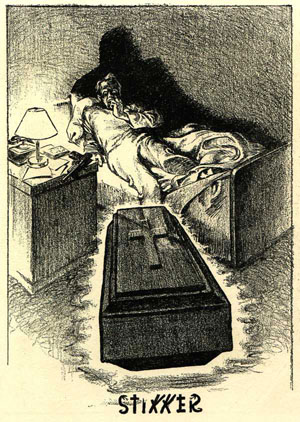
Stikkerens skæbne (The Informer’s Fate), underground drawing by Gustav Østerberg, 1944, reproduced in Besættelse: Tegninger 1940-45 by Gustav Østerberg, Samlerens Forlag, 1945. More in Danish here.

In the latter period of the occupation, informers were a serious threat to the Danish Resistance. In the Autumn of 1943 the Danish Liberation Council (Frihedsrådet), made up of representatives from the major resistance groups, agreed unanimously that it was necessary to “liquidate” informers, that the Resistance couldn’t continue unless action was taken.

The Liberation Council first considered the possibility of setting up a secret court to try a case before carrying out a liquidation. But this idea was dropped, partly because there wasn’t time for such a procedure if there was a danger that an informer might go to the Gestapo with dangerous information, and partly because liquidations were not to be seen as punishments, but as defensive actions by the Resistance.

In Copenhagen, two large Resistance groups, Holger Danske and BOPA were responsible for most killings of those believed to be informers. In Jutland most liquidations were carried out by specialist groups that could be called in by local Resistance members when they believed they had discovered an informer.

At first liquidations took place as a rule only after careful investigation, and after permission was granted from someone higher in the Resistance movement. But as the fight with the occupation forces intensified and the numbers of liquidations increased, it became more common for groups to decide on their own initiative to carry out a killing. About 400 were killed in all. Some mistakes were made. Nevertheless practically all those killed had in one way or another sided with the Nazis.

The German occupation forces responded with revenge killings, beginning with the murder of the outspoken playwright and priest Kaj Munk on January 4th 1944. Over 100 Danes were victims of these revenge killings. The revenge killings were part of a wider Nazi policy of using terror in response to the Resistance, rather than police work. This policy was adopted on the direct orders of Hitler, and was predominantly carried out by Danish collaborators.


In August 1944, the Folk og Frihed (People and Freedom) underground journal published an article arguing that:

“In the Danish society founded on law which must be rebuilt, everyone who has killed another person stands responsible for their actions, and it will therefore be necessary to hold a police investigation or legal inquiry every case.”

And further that:

Without a doubt good Danes who have taken it upon themselves to eradicate informers will on their own initiative report themselves [after the war] and account for their actions. The necessity of this will be obvious, because neither the case nor those concerned can bear that such a thing be kept secret, and because there must be confidence that possible or alleged abuse will be uncovered and punished.

Turning to what the result of a legal inquiry would be for killers of informers, the Folk og Frihed article asserted that “it is a given that a healthy and intrinsic sense of justice will demand that they be acquitted,” but questioned how would these cases would actually stand in law. Danish law regarding self-defence was outlined, or rather what in Danish is called nødværge, or emergency-defence.

Emergency-defence is dealt with by Paragraph 13 of the Penal Code, which ‘Actions taken in emergency-defence are penalty-free, in so far as they have been necessary to oppose or avert an underway or impending unjust attack, and do not exceed, what with regard to the dangerousness of the attack, the attacker’s person, and the rights of the party under attack, is justifiable.’

So for emergency-defence to apply, the action must have been both necessary and justifiable. This applied to the killing of an informer, it was argued.

This is necessary, that is to say there is no gentler means than the killing of informers by which to prevent their informing, which would regularly would result in to person informed on being killed; the law does not demand that the threatened attack should be directed against the one carrying out the act of emergency defence. [...] Furthermore, as it is the life of the informed upon that is at risk, then the killing of the informer does not exceed what is justifiable. Finally it can be emphasised that informing naturally is an ‘unjust attack.’

The concept of an emergency-defence attack rests on the consideration that the exclusive right of the State to punish must bear the qualification that the private person has a right to attend to the defence of their own or others’ rights, where the State’s assigned law enforcers cannot take charge. This fundamental point of view, which recurs in the law of all civilised states, is also applicable to a high degree in the existing situation.

It is also normally emphasised as something characteristic of an emergency-defence situation that it must be of such a character that in itself normally leaves no doubt as to the attack’s illegality. The Penal Code has in mind on the whole a reaction to an acute attack situation. This is what has raised some doubt as to how widely the emergency-defence point of view kan be applied to the killings of informers, which seldom are carried out in direct connection with the act of informing. However this cannot be conclusive. The words of the Penal Law are fulfilled, in that they only require an ‘impending unjust attack’ and that the attack is ‘impending.’

The article follows the main argument on emergency-defence with a brief consideration of how the existence of a state of war might supplement such an argument, and closes with mention of the constitutional power of the crown to grant amnesty should the argument fail.

In October of 1944 Folk og Frihed published one of the best known underground books of the occupation, Der brænder en Ild (A Fire Burns). The book was re-issued after the war in a legal version with all of the contributors names added.

Amongst them was author Martin A. Hansen, whose contribution, Dialog om Drab og Ansvar (Dialogue on Killing and Responsibility), imagined Socrates in dialogue with his friend Simias defending the killing of informers.

In 1953 he commented on his defence as follows:

If anyone were to read Dialogue on Killing and Responsibility, they would perhaps not feel so much the troubles of distant nights. On the other hand they would surely notice, that the Dialogue foresees something of the fate of those who were the instrument, the killers. Bad times might come for them. And they did come. The reader would further notice that the Dialogue is seriously mistaken on another point. It declares that these judgements and liquidations would, after the war, be voluntarily set before Danish courts, so as to lay the burden of these emergency-defence measures upon the shoulders of the people by means of a legal act. In this I was completely mistaken.

An indication that this is how it would happen was in those times a condition one had to make, the only condition I saw myself justified in setting out, before tackling this problem of external origin. For other reasons one couldn’t evade it, once one was on board and approved action. I did however receive the requested indication: decisions would be re-examined later. I don’t know from whom the message came, and I haven’t attempted to trace it. There were also many who believed that was how it should be. It didn’t happen. That was a mistake.
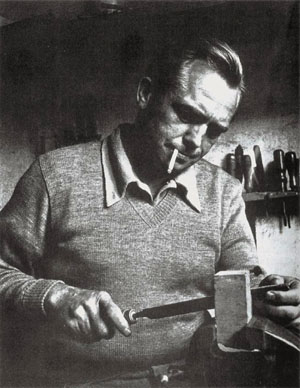
Photo from Martin A. Hansen - Fra Krigens Aar til Døden by Ole Wivel, Gyldendal 1969, (source).

After the liberation, Hansen learned that at least two of the fallen amongst the Resistance had joined the fight having been convinced of its legitimacy by his writing. As for those killed as informers, he is described in an essay by Kasper Anthoni as having retained a personal self-imposed guilt for some of killings carried out by the Resistance. In notes from his diaries, published in the literary magazine Heretica in 1953 under the title July 44, he expresses the horror that arose in him when he acknowledged that the words in the Dialogue had been used as a direct justification for killing:

In forming a nakedly honest justification for the liquidation of informers, the justifier must make himself perfectly clear, who he is and what he is doing. He hands a tool on to others who are going to use it. Ideally they are, surely, just as obliged to themselves take a position and look the dangers in the eye. But several will of course do it via him, that is why he has been given the job. They keep to his reasoning. And which one it is that can’t avoid responsibility is easy to see.
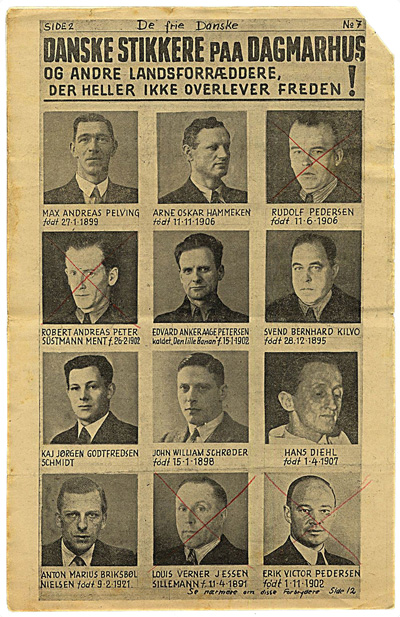
Danske Stikkere paa Dagmarhus
From the underground newspaper De frie Danske (The Free Danes), April 1944, photographs of informers.

In August 1945 the Social Democrat member of parliament Professor Hartvig Frisch said in a radio broadcast that the killings of informers by the Resistance was murder. Though he had a long record of anti-fascist beliefs, his 1933 book Plague on Europe being banned under the Nazi occupation, he had in 1943 also condemned acts of sabotage by the Resistance as terrorism. His argument on the killings of informers was that they were strategically unwise “as the Germans had all of the resources of power, and one could foresee that the result would be a whole explosion of murders of quite random and innocent people.” Further he argued that the effect had been to “brutalize a large part of Danish Youth. One can’t go up to a man and give him six shots in the face, when he opens the door, without it leaving a mark mentally.” He maintained the killings were unnecessary, pointing to Norway where they were avoided.

The resistance group Holger Danske replied with a press release, pointing to parliamentarian Hartvig Frisch’s “distinctly passive position, both personally and in his pronouncements throughout all of the period of fighting.” They made three points:

1. All of the Resistance Movement have in the period of fighting been in agreement that informer-liquidations can only be seen from the point of view of emergency-defence.

2. To all from the highest leadership to the common saboteur, the informer was an extremely serious personal threat, and it was often simply and literally a question of life or death, as to whether the informer was rendered harmless.

3. Holger Danske wish to point out that even though we were soldiers in the Resistance Movement, who by free will showed discipline and did our duty, there has on our side never been any doubt that the informer-liquidations were practically and morally well-founded, and we will stand in full solidarity with the members of the Liberation Council, whose policy on liquidations the Social Democratic parliamentarian now attacks so strongly.

Hartvig Frisch lost his seat in parliament as a result of his comments, but was re-elected later and served as education minister.

There are a number of comparisons I’d like to make between the killing of informers by the Danish Resistance and other situations, at other times, in other places, but I’ll save them as this is already a rather long post.

Declaration of ignorance: My knowledge on the topic is not any deeper than what you see here, and my sources for the above are all online, albeit mostly in Danish. The translations at least are my own.

My main source for general information on informer-liquidations was an article by historian Bjørn Pedersen written for an educational website run by the 5th of May Committee (connected with the Danish Resistance Veterans organisation), in co-operation with the Danish Ministry of Education, with some further detail from The Museum of Danish Resistance, part of the National Museum of Denmark.

My source on Folk og Frihed and Martin A. Hansen was first of all the Danish Royal Library’s online exhibit of underground publications from the time of Nazi occupation, and secondly the essay by Kasper Anthoni, I sort/hvid og farver: Alvor og humor i efterkrigstidens kortprosa, as well as excerpts from an article by David Bugge, Digterens janushoved, published in Transfiguration vol. 3:2.

Monday, 22 December 2008

Failing to understand Somalia

Bill Roggio of The Long War Journal says Matthew Yglesias is criticising the Bush administration for the wrong reasons on Somalia, and goes on to give better reasons, all here.

Friday, 12 December 2008

Brother, can you spare me some U235?

In the New York Times earlier this week, a review of three books on nuclear proliferation, with a handy chart. Via A second Hand Conjecture.

In the current issue of The New Yorker, a dedicated hobbyist builds his own replica of Little Boy, the bomb dropped on Hiroshima. Has he got it right? There’s just one element needed to find out if it works.

Wednesday, 26 November 2008

Are Pirates the Problem, or the Solution?


There are very few people dying from piracy. The areas that are being governed by the pirate companies are functioning and less violent than areas where piracy does not exist, indeed pirate cities are thriving. The pirates are not only commercial in nature, but they are enemies of the Islamic extremists that represent the enemy of the United States. It sounds crazy to say, but the pirates are essentially the secular, liberal capitalists of Somalia, and the United States would prefer to deal WITH not AGAINST those types of people. Know your history, the Europeans preferred dealing with the Brashaws of the Barbary states than the alternative, the Islamic militant armies. We are essentially allowing the pirates to build themselves as regional Brashaws of Somalia with the ransom money from piracy, while the Islamists who remain violent are struggling for funding.

Related, Neo-neocon on the unforseen consequences of the US withdrawal from Somalia under Clinton, of which more in this 2002 New Yorker article by Lawrence Wright, The Man Behind Bin Laden:
In 1993, bin Laden dispatched Mohamed Atef to Somalia to look for ways of attacking the American military forces that were participating in an international famine-relief effort. Bin Laden gloried in the fact that his men had trained the Somali militiamen who shot down two American helicopters in the ‘Black Hawk Down’ incident, in October of that year, prompting President Clinton to withdraw all American soldiers from the country. “Based on the reports we received from our brothers in Somalia,” bin Laden said, “we learned that they saw the weakness, frailty, and cowardice of U.S. troops. Only eighteen U.S. troops were killed. Nonetheless, they fled in the heart of darkness.” 
Earlier post on Somalia and pirates here.

The above illustration is a sketch for my current Dutch book project.

Friday, 21 November 2008

Somali pirates hijack front page

pirate ship
Yesterday, the International Herald Tribune, probably the most sober daily available at my corner shop, gave most of its front page over to the pirates and their booty. But if you’re worried about murderous threats in those waters then people smugglers seem worse. Another hazard on a lawless coast is illegal dumping.

What the pirates do underline once again is that problems in failed states don’t stay within failed states. It may be possible to contain a hostile government in control of its own territory, but it’s impossible to contain a failed state.

Detailed pirate coverage can be found at EagleSpeak.

Illustration: sketch for the book in progress.

Against a false choice

It has become quite fashionable to say there is no military solution: in Iraq “the solution in Iraq is political, it is not military,” in Afghanistan “there can be no military solution to this conflict only a political one,” and in the Democratic Republic of Congo “there is only a solution to this by discussion and not by military means.” So it was some small relief to read the words, “this is not about political settlement or humanitarian aid or military protection: it is about all three.” 

Whether action follows is another matter - three thousand more peacekeepers doesn’t quite sound like the whole world rolling into action.

The comparative explanations of the geographic scale of the problem have been varied. Congo is as big as Europe. But the eastern region currently in crisis is about the size of Sierra Leone, implying that 3,000 of the right troops might be more than enough, if only without blue helmets. Or it’s twice as big as Belgium, which given Belgium’s political problems makes it potentially the size of two times two, that is to say four little countries.

If you want a reason not to act, then the bigger the better, maybe. Or more sensibly one might think it’s better to act while the problem is contained within two Belgiums, rather than wait once more for the all-of-Europe-sized disaster.

And it doesn’t need to stop there. I’m reminded of this map.

Tuesday, 4 November 2008

Weighing Obama versus McCain

Marko Attila Hoare sums it up.

Daniel Stark closes with a quote from the Wall Street Journal.

Most of my earlier posts on the US election:

Segregation, parts one and two.


A couple of people have said that Obama will be more like Clinton than Carter. This I do not find reassuring. 

Who wants another president who will hesitate for years over a massacre like Bosnia, with more care for domestic opinion polls than for doing what is right?

Who wants another Somalia? A scramble to withdraw in the face of public unhappiness, a disaster which strengthened Al Qaeda and left that country in a disastrous state from which there is still no sign of recovery.

Who wants another Rwanda?

But Samantha Power was one of his advisers, so surely he will act against such atrocities? Sorry, no, I get no reassurance from an academic who can describe victims of ethnic cleansing as exercising a choice.

The issue of Iraq has faded from consciousness as violence falls, and while Obama has never withdrawn his ‘withdrawal in 16 months’ policy, it has been allowed to be forgotten for now, along with his vociferous opposition to the surge.

Here though is a reminder of what the consequences would have been of following Obama’s policies over the last two years, from David Kilcullen:
The question of whether we were right to invade Iraq is a fascinating debate for historians and politicians, and a valid issue for the American people to consider in an election year. As it happens, I think it was a mistake. But that is not my key concern. The issue for practitioners in the field is not to second-guess a decision from six years ago, but to get on with the job at hand which, I believe, is what both Americans and Iraqis expect of us. In that respect, the new strategy and tactics implemented in 2007, and which relied for their effectiveness on the extra troop numbers of the Surge, ARE succeeding and need to be supported. In 2006, a normal night in Baghdad involved 120 to 150 dead Iraqi civilians, and each month we lost dozens of Americans killed or maimed. This year, a bad night involves one or two dead civilians, U.S. losses are dramatically down, and security is restored. Therefore, even on the most conservative estimate, in the eighteen months of the surge to date we have saved 12 to 16 thousand Iraqis and hundreds of American lives.
Who would have preferred Obama’s path?

Of course you can always hope, like Hitchens, that Obama is learning. But my hopes for Obama are more than equalled by my fears.

Thursday, 11 September 2008

Heart of Darkness, the Core and the Gap - 3

jan de hartog andre morell pamela brown frederick richterContinued from here.

First post in the series here. Fourth post here. Fifth post here.

Is Russia a Core state?

The most obvious objection to Thomas PM Barnett’s view of the Russian invasion of Georgia is of course the one he begins by anticipating, namely that including Russia amongst the Core nations in his global strategic model is a mistake. His reasoning for including Russia seems based on two points. One, Russia’s economic connections with the wider world are strong enough to qualify, and two, not including Russia in the core is too costly in terms of greater demands on remaining Core nations, both in dealing with Russia and with dealing with the rest of the Gap without help from Russia.

On the first point, I’m unclear why TPM Barnett feels Russia qualifies for the Core while other oil rich states do not; I’m thinking particularly of those nations in the Gulf who invest widely in other countries and are therefore important in the global economy beyond their role as suppliers of oil.

80% of Russia’s exports are commodities; there is not the focus on manufactured goods or services seen in China and India, other big countries that TPM Barnett also counts as New Core states. Despite Russia’s gas and oil boom, Russian economic growth this century is below average amongst former Soviet states. In 2007 the Russian economy grew at only two-thirds the rate of the Georgian economy for example, though the other side of that story is that Georgia is growing from a much lower base.

There is a strong danger then that the current Russian economy based on exploitation of natural resources may be stuck in an asset stripping mentality, and the only expansion it will be capable of will be in gaining control of more natural resources beyond the state’s borders, by fair means or foul.

The bigger problem in regarding Russia as a Core state is in the attitude of the current Russian leadership to the rule of law, and how this affects globalisation, firstly in working against the integration of the Russian economy into the global system, and secondly in the role Russia plays in affecting other nations’ progress towards global economic integration.

Russia has long been a gangster state, most obviously in the time of Yeltsin when various parties competed in a lawless scramble to secure assets as the Soviet state was demolished, but also before then when the gang in control was the Party, when there was no law outside of the Party, no higher authority, no alternative. Now there is one gang in charge again, and having defeated or incorporated the other gangs at home it now uses the same gangster methods abroad, in Ukraine, in Britain, and now in Georgia.

Use of violence with no legal sanction is only the most extreme manifestation of gangsterism here. Russia’s pipeline policy is indicative of a gangster mentality. They want a monopoly on the dope they’re peddling, squeezing competing supplier nations, pushing out foreign investors while pushing into foreign markets, threatening cold turkey on anyone who doesn’t co-operate.

TPM Barnett sets aside systems of political government when considering whether a country belongs in the Core. That China is a one party state, that Russia has become a Potempkin democracy, these issues are less important than that China and Russia are ‘actively integrating their national economies into a global economy’. So China qualifies as it imports raw materials from round the world, exports manufactured goods round the world, and invests abroad. But does Russia qualify?

Made in China goods are ubiquitous, and are now central to the world economy. China’s need for raw materials worldwide gives it an interest in global stability. While some of its resulting engagements in the wider world are negative, most prominently in Sudan, and look like exporting totalitarianism rather than encouraging globalisation, it is also clear that China is growing globalisation within its borders. The results may yet confirm TPM Barnett’s view of economic integration being more urgent than political reform.

To Russia: I don’t see Made in Russia on anything I buy in the supermarket. I do see spam apparently facilitated by Russian ISPs clogging my inbox. I do see the after-effects of a London house price boom fuelled partly by wealthy Russians insecure about staying in Russia. I see antique-looking Russian strategic bombers showing off in the UK ADIZ. And I see the flames on our stove burning blue and hear the hum of the gas fired boiler when we run the bath. The bills are going up, and we’re looking for alternatives.

The Russian monopoly strategy on energy is not compatible with advancing a competitive global economy. Neither is the focus on asset-stripping which reduces the Russian economic system to commodities out, money and manufactured goods in: a classic Gap economy, like the Gulf states, like Nigeria, or to return to Conrad, like the Congo. The company in this case is not a Belgian elite exploiting African resources, it’s a Russian elite exploiting the resources of Russia and its neighbours.

While the Chinese model requires dispersal of economic power amongst the population to foster enterprise and competition, Russia’s asset-stripping, dope-peddling model is leading to the opposite, a re-centralisation of power. The ruling gang are maintaining domestic support through nationalism promoted via a controlled media rather than broad-based economic progress. The population is not empowered in such an economy. It’s out of their control as much as it is for the native population in Heart of Darkness. And the populations of neighbouring states falling under Russian control would see no benefits, except for those amongst them given the privilege of preying on their neighbours. From Joseph Conrad’s book:
‘A slight clinking behind me made me turn my head. Six black men advanced in file, toiling up the path. They walked erect and slow, balancing small baskets ful of earth on their heads, and the clink kept time with their footsteps. Black rags were wound round their loins, and the short ends behind waggled to and fro like tails. I could see every rib, the joints of their limbs were like knots in a rope; each had an iron collar on his neck, and all were connected together with a chain whose bights swung between them, rhythmically clinking. Another report from the cliff made me think suddenly of the ship of war I had seen firing into a continent. It was the same kind of ominous voice; but these men could by no stretch of imagination be called enemies. They were called criminals, and the outraged law, like the bursting shells had come to them, an insoluble mystery from the sea. All their meagre breasts panted together, the violently dilated nostrils quivered, the eyes stared stonily uphill. They passed me within six inches, without a glance, with that complete, deathlike indifference of unhappy savages. Behind this raw matter one of the reclaimed, the product of new forces at work, strolled despondently, carrying a rifle by its middle. He had a uniform jacket with one button off, and seeing a white man on the path, hoisted his weapon to his shoulder with aclarity. This was simple prudence, white men being so much alike at a distance that he could not tell who I might be. He was speedily reassured, and with a large, white, rascally grin, and a glance at his charge, seemed to take me into partnership in his exalted trust. After all, I was also a part of the great cause of these high and just proceedings.’
Continued here.

Related: The Real Price of Oil by James Surowiecki, The New Yorker, December 3 2001.

Top image: illustration for the Times Higher Education Supplement, 17 February 1995, accompanying a review of Cold War histories. Click on the image to see the article.

Monday, 8 September 2008

Heart of Darkness, the Core and the Gap - 2

Continued from here.

Part three here. Part four here. Part five here.

Maps, jargon, and economics before all else

Thomas PM Barnett’s series of books on his Core and Gap strategic theory begin with The Pentagon’s New Map. Declaration of ignorance: I haven’t read it. I’m going instead by the large amount of information on his sprawling website. First, here is the map:


Or at least a detail of the map - click on it to see the whole world divided into Core and Gap, or download a PDF version here. As to what these divisions mean, TPM Barnett provides a glossary:
FUNCTIONING CORE: Those parts of the world that are actively integrating their national economies into a global economy and that adhere to globalization’s emerging security rule set.

NON-INTEGRATING GAP: Regions of the world that are largely disconnected from the global economy and the rule sets that define its stability. [...] These regions constitute globalization’s ‘ozone hole,’ where connectivity remains thin or absent in far too many cases. Of course, each region contains some countries that are very Core-like in their attributes (just as there are Gap-like pockets throughout the Core defined primarily by poverty), but these are like mansions in an otherwise seedy neighborhood, and as such are trapped by these larger Gap-defining circumstances.
So this division is defined by economic infrastructure. It’s not defined by political systems, not by levels of industrialisation or wealth, and not by military might - he believes these are secondary characteristics that flow from globalisation.

TPM Barnett argues that all serious strategic threats come from the Gap, and so to ensure future security the Core must work to close the Gap by expanding globalisation, by use of force where necessary. A repeat of the Cold War strategy of containing the enemy is insufficient, because the Gap is already defined by failure, and it is from failure that the danger comes. Afghanistan and Iraq are key examples for him, both of how threats come from the gap, and of how military force will in the future be used in the Gap rather than between countries of the Core.

And this is where I came in, because TPM Barnett places China and Russia in the Core, and conflict with China and Russia is at best a distraction from the main task according to his theory. But I don’t want to get onto that yet. First Heart of Darkness, and the steamer landing soldiers and customs officers all down the coast of Africa. The resonance with the New Map proposal is obvious. And TPM Barnett’s history of globalisation includes the colonial period. From the glossary:
The history of globalization can divided into three parts, each governed by its own rule set.
Globalization I from 1870 to 1914, was ended by the start of World War I.
Globalization II from 1945 to 1980, was initiated by the United States at the end of World War II, and continued until the effective end of the Cold War.
Globalization III (1980 -2001) has been an era of relative peace and enormous economic growth around the world that has lifted hundreds of millions of people out of poverty, but whose rule sets have now been challenged by rogue states and international terrorists, as exemplified by 9/11.
Here is someone who sees globalisation as the global strategic priority, and yet seems to confirm the far left view of globalisation as a continuation of Western imperialism. But while he sees a continuity he also wants to differentiate ‘Globalisation III’ from what went before. From the book proposal for The Pentagon’s New Map:
Does that sound like America running a global empire? It shouldn’t. We’re interested in enforcing minimum rule sets, not the maximal rule sets associated with imperialism. We want a level playing field not just in global trade, but in global security as well. We want to administer the global security system, not rule it. Like those ‘system administrators’ that keep the Internet up and running, America needs to play system administrator to the global security network. We need to keep globalization up and running - to be, in effect, its bodyguard.
Having not read the book nor its sequel, I don’t know whether this aspect survives intact therein. Four years later, he seems to be less sure that America is to be the sole systems administrator for globalisation, and instead is talking about competing rules being advanced by other Core nations as they move into the Gap. They don’t need to be America’s rules, just rules that America can live with. From TPM Barnett’s blog, August 21 2008:
I want a confident, demanding Russia. I need it to run some parts of the world and help shrink some parts of the Gap I won’t pretend anybody else is stepping up to handle. But I need a rule set for how that’s done that I can live with, along with the rest of the Core. By not integrating Russia better into Core institutions (like NATO, which should have been killed a while ago and reborn immediately as something from Vancouver to Vladivostock - remember that one from Jim Baker?), we’ve done a half-assed job, giving Russia just enough connectivity [...] to get rich but not enough larger [political-military] context to truly make itself happy and secure inside the Core.
That snippet comes from a follow-up to his post on Russia’s invasion of Georgia that got me started on reading all this. Here’s a big piece of that, where he explains his opposition to returning to a Cold War view of Russia:
Russia’s too much in the club (or Core, as I call it) to make such a divorce anything but highly disruptive to too many economic and investment and network interests, and therein lies my basic position on Russia belonging to the Core. Until it transgresses enough to resurrect itself as a credible direct-threat scenario (meaning we have a reasonable anticipation of possible direct war with Russia), we - along with the rest of the Core - are going to finesse this situation.

Being in the Core doesn’t mean never going to war, especially against Gap nations. Indeed, my whole point in making the original delineation was to point out that while intra-Core war becomes an increasingly distant possibility, wars inside the Gap by Core nations will be anything but. Just look at our record since the end of the Cold War.

The notion of the Core doesn’t presuppose that only America will have permission to do this sort of thing unilaterally. In fact, in both my books, I cited the danger of other Core powers starting to replicate our example if we weren’t careful about embedding our own interventions within an acceptable A-to-Z rule set that the Core as a whole could sign up for, meaning we’d eventually see other Core great powers launching their own efforts inside the Gap - according to their own rules and agendas. To some extent, Russia’s kinetic version is as challenging as China’s non-kinetic version - say - in Africa.

But make no mistake: the longer the U.S. gives off the vibe that it’s a ‘dangerous chaotic world’ where Core great powers do what they must to protect their interests, the more we will see this sort of behavior. If I’m Russia, and I’ve been watching imperious Washington this past two decades, I feel wholly within my rights in my own neighborhood, because those Americans certainly show themselves to take advantage or do what they feel they must in places all over the world but especially in their own backyard.

Again, this is where the strategic vision ‘thing’ or the lack thereof really hurts. We go off on a strategic bender after 9/11 and start remaking the Middle East as we see fit and we can’t expect every other Core great power to simply stand by and see what happens. We set the example, we model the behavior, and we eschew the larger schemes of cooperation as ‘naive’ or ‘too compromising’ or ‘too distasteful’ because ‘those regimes’ aren’t democracies like we are, and we’re going to find ourselves battling alternative great-power rule sets, which - in effect - Russia is proposing right now regarding the Caucasus.
He expresses the argument in more measured tones in this column dated September 7th.
Think about what made America the world’s most stable and prosperous democracy for almost a century and a half: the middle class ideology that emerged when we knit together our sectional economies into a continental juggernaut following the Civil War. That class consciousness wasn’t born when the victorious North imposed itself on the prostrate South but when the ambitious East integrated the frontier West.

Today’s globalization echoes American experience as West networks East and East integrates South, reducing global poverty at speeds never before seen in human history. This international liberal trade order, modeled on our ‘uniting states,’ is America’s greatest gift to the world.

[...]

The problem is the time required, as people must be enriched before they can be empowered - Maslow’s hierarchy of needs. Such strategic patience is difficult for an America that idealizes its own tumultuous political history.

[...]

Now America faces the great temptation to swap out the frustrating ‘war on terror’ for the more familiar dynamics of cold war with Russia. What disturbs me most about that choice? The war on terror accurately targets extremist opponents of globalization’s advance, while strategic brinkmanship with Moscow's oligarchs does not.

Pursued with our usual demonizing tendencies, a ‘league of democracies’ combating rising great power autocracies will result in globalization being fenced off into a cluster of armed regional camps, replete with destructive trade protectionism.

Russia’s economic ambitions are as understandable as its penchant for brute force is unacceptable, but Moscow doesn’t seek to overthrow our international liberal trade order nor does it dream of civilizational apartheid like radical Islam. The same is true of autocratic China.
While I see much of worth in what TPM Barnett writes, my opposition to his conclusions on Russia has clarified to a great degree, and led me to also find fault elsewhere in his proposals. Now that I’ve sounded the depths I’ll aim to navigate my own passage through these murky waters in the coming days.

Continued here.

Friday, 5 September 2008

Heart of Darkness, the Core and the Gap

From Joseph Conrad’s Heart of Darkness:
‘I left in a French steamer, and she called in every blamed port they have there, for, as far as I could see, the sole purpose of landing soldiers and customs officers.’
In the late 19th Century, Marlow, an English sailor looking for adventure, is a passenger on a steamer going down the west coast of Africa. He has signed up with the Company to captain a riverboat, but first comes this long journey as spectator.
‘The sun was fierce, the land seemed to glisten and drip with steam. Here and there greyish-whitish specks showed up clustered inside the white surf, with a flag flying above them perhaps. Settlements some centuries old, and still no bigger than pinheads on the untouched expanse of their background. We pounded along, stoppped, landed soldiers; went on, landed custom-house clerks to levy toll in what looked like a God-forsaken wilderness, with a tin shed and a flag-pole lost in it; landed more soldiers - to take care of the custom-house clerks, presumably. Some, I hear, got drowned in the surf; but whether they did or not, nobody seemed particularly to care. They were just flung out there, and on we went.’
I read Heart of Darkness for the first time on our recent trip to the wilds of the Isle of Mull, and with the insect bites, the grass and moss and other vegetation growing right down to the edge of the salt water, the tree trunks covered with moss and lichen and other life soaking up the moisture and growing like a green plague, the green and gold hills across the Sound of Mull in mist and sun, well, the whole effect was quite convincing at times: Africa in Scotland.

It was curious reading a book that was already so familiar before even opening it, from all the references made to it, from Apocalypse Now, and from Jan de Hartog’s novel of the Dutch East Indies, The Spiral Road. I want to write about his colonial tale in a later post, but first to a more recent echo I heard as I read the above passage - the strategic model proposed by Thomas PM Barnett of a world divided into the Core and the Gap.

TPM Barnett has been around awhile, has written successful books about his view of the world, and seems to have quite a following. (See for example the Information Dissemination post I linked to at the end of my last post before the Mull Expedition.) However I only came across his writing in the last month, and in circumstances not suited to winning me over.

The first I read of his was about how to react to Russia’s invasion of Georgia, a piece which placed much greater emphasis on maintaining Russia’s position in the Core part of his global strategic model, rather than giving much consideration to how to defend nations on Russia’s borders threatened by a gangster regime. My gut was opposed to the sentiment of the post, but there were strong arguments there, and it was rooted in that strategic model of his, with which I was wholly unfamiliar.
‘It was upward of thirty days before I saw the mouth of the big river. We anchored off the seat of the government. But my work would not begin till some two hundred miles farther on. So as soon as I could I made a start for a place thirty miles higher up.’ 
Continued in part two here.

Part three here. Part four here. Part five here.