
Showing posts with label ireland. Show all posts
Showing posts with label ireland. Show all posts
Thursday, 15 November 2018

Tuesday, 2 January 2018

Monday, 5 October 2015
An alternative letters page for The Irish Times

Sir,
Phenomenal. Another psychedelic “analysis” piece from Michael Jansen on Saturday (Assad remains in power as bulwark against Islamic State). This writer has already in your pages (Op. Ed July 2nd, 2011) spectacularly confused the MASSACRE of Hama (1982) when the current presidential incumbent's father slaughtered up to 40,000 people (estimates vary) in the city of Hama with the BATTLE of Hama (605 BC.) between the Babylonians and the Egyptians. In her latest wide-ranging synopsis of the Syrian and middle-eastern crisis, she has managed in the nearly 1000-word article never once to mention a single human-rights violation by the Assad regime. She gushes of Assad “his army constitutes the only force on the ground countering and containing Islamic State (IS) and al-Qaeda radicals.” That surreal assessment requires no further comment. She provides no data to back up her outlandish claims such as Assad having the backing of the Kurdish minority. Nor does she provide any analysis on why it would possibly be that people who are being bombed out of opposition-held towns and districts would flee to regime-held districts insofar as that is the case. In the context of the regime's terrorism strategy of barrel-bombing, sniper attacks, chemical weapons attacks, starvation sieges, etc., etc., the conclusion of the analysis: “the flow into government-held areas demonstrates strong aversion to his opponents” really beggars belief.
Yours, etc.
Michael Lenehan
The Irish Times article referred to by the letter is here: Assad remains in power as bulwark against Islamic State (Analysis: Western leaders know Syria president’s army is only ground force in region) by Michael Jansen.
In it, not only does Ms Jansen implicitly deny the existence of Free Syrian Army and Syrian Kurdish forces fighting ISIS, she asserts that “Syrian protests, far smaller than those elsewhere, were within days infiltrated by armed men backed by external interests and powers seeking his overthrow,” a grotesque distortion of the peaceful protests of 2011 that were met with gunfire by the regime, as well as with torture, mutilation, and murder in regime prisons.
And as Michael Lenehan points out, on internally displaced people fleeing violence, Ms Jansen claims that “the flow into government-held areas demonstrates strong aversion to [Assad’s] opponents,” without making any mention of the daily bombing of civilians in opposition-held areas by Assad’s air force.
It’s a miserable state of affairs for Ireland’s old newspaper of record that it should now rely on such a blatant propagandist for the Assad dictatorship to fill its pages.
Photo by Daniel Dudek-Corrigan.
Monday, 22 September 2014
I’ll be talking at the Liverpool Irish Festival, Friday 24th October

As part of the Liverpool Irish Festival I’ll be at Liverpool School of Art & Design on Friday the 24th of October at 2pm, talking about illustration and sea monsters. Ireland’s part in the development of submarine warfare is also likely to get a mention.
Image from Worse Things Happen at Sea, published by Nobrow.
Wednesday, 21 May 2014
Philip Moss and Paki Smith paintings on show in Dublin

My friend Philip Moss (above) is having a joint exhibition with Paki Smith (below) at the Taylor Galleries, Dublin, from the 6th to the 21st of June.
Here’s an earlier post with a film about Philip’s paintings.

Thursday, 3 April 2014
‘Video Shop’ plays in the London Independent Film Festival
Congratulations to John Dog whose recent finger puppet production Video Shop is playing next weekend in the London Independent Film Festival – Saturday April 12th at 6pm to be precise, as part of a 90 minute program of music videos. For those of us who can’t make it, we’ll have to make do with watching it again on YouTube:
UPDATE: And we have a winner! Best Animated Short: Raymond Butler for Video Shop!
UPDATE: And we have a winner! Best Animated Short: Raymond Butler for Video Shop!
Wednesday, 12 March 2014
Launching my Leporello: sailing from Dublin Bay to the Swiss Alps

Worse Things Happen at Sea is the title of my forthcoming Leporello book from Nobrow Press. It’s a concertina book of ships and sea monsters, a series of disasters in both its subject matter and in the history of its making. During the drawing of it I’ve been losing my mind, losing my eyesight, and lost a couple of months’ work in a burglary. Now the art is all delivered, so barring a flood at the printers, it should be on sale in the next few weeks.
To launch the book, I’ll be travelling to a couple of events in Ireland and Switzerland with fellow Nobrow artists. Next week, illustrator Bjørn Rune Lie, Nobrow partner Sam Arthur, and myself, will be going to Offset, a graphic design festival in Dublin that runs from the 21st to the 23rd of March. Sam will be telling the story of Nobrow on Friday at 12 noon on the Magenta Stage, while Bjørn and I will be talking about our latest books on Sunday at 12 noon, again on the Magenta Stage.
Then in April, Luke Pearson, Andrew Rae, and myself, will all be exhibiting work at the Fumetto comics festival in Lucerne, Switzerland. As well as original drawings for Worse Things Happen at Sea, I’ll also be showing paintings from Het Zeemans-ABC (A Sailor’s ABC) the Dutch Little Golden Book by Nienke Denekamp that I illustrated a while back. Fumetto runs from the 5th to the 13th of April, and I will be there myself ’til the 9th.
Friday, 13 December 2013
The Random Walk
Christmas is saved, thanks to John Dog. Here’s his new album, and it’s available to download – for free!
In case you missed it, his lovely promo for the first track, Video Shop, is below. Find more John Dog songs, as well as full lyrics to sing along to, on Raymond Butler’s Bandcamp page.
Wednesday, 20 November 2013
Video Shop
John Dog’s latest, Video Shop, fantastic period videotography in this rewind to the horrors of the late 20th century, and with finger puppets! This is the first song from his upcoming collection The Random Walk.
More John Dog songs here.
Saturday, 14 September 2013
Paintings by the jam man
This short film is of a recent exhibition by Irish artist (and friend) Philip Moss of Glenties, Co.Donegal. See more of his paintings at www.philipmossart.com.
The jam? That’s to be found at Filligans.
Tuesday, 16 April 2013
Martyrs and murderers
Terry Glavin is a writer I’ve enjoyed greatly, and I’ve written previously of his powerful book, Come from the Shadows: The Long and Lonely Struggle for Peace in Afghanistan. He is very strong on describing the confusions of anti-imperialists in the West that often cause them to support or excuse murderous illiberal forces that oppress rather than liberate.
However when it comes to Ireland, “it’s kind of personal” he writes. Family history and family loyalties seem to mean that a similarly robust analysis is to be avoided.
Here’s his most recent post, on Margaret Thatcher and Northern Ireland: At best, a slightly lunatic mediocrity. Now I have no objection to anyone attacking Thatcher, whether for her role in driving a divisive political culture that victimised the weakest in society, her support for homophobic legislation, or her relationship with Pinochet, to give some key examples. But Terry’s chosen area of criticism is her policy towards the 1981 Provisional IRA hunger strike.
Here are his opening paragraphs.
I left the following comment a couple of days ago, though it has yet to pass moderation. Terry may be busy elsewhere.
There is one other aspect of Terry Glavin’s post I want to mention. He quotes approvingly the following from an article by Timothy Lavin of Bloomberg, blaming an escalation in Provisional IRA violence on Thatcher’s policy towards the hunger strike:
For anyone unfamiliar with the 1981 hunger strike, it’s important to note that all the prisoners had been convicted in court. The hunger strikers were demanding political prisoner status with attendant privileges, not disputing their convictions or sentences. In general I’m in favour of prison conditions being as civilised as possible, but I’m not in favour of one murderer getting more favourable treatment than another because of a claimed political motive.
Also for those unfamiliar with detail, it’s important to note the low level of electoral support for the Provisional IRA’s political wing (Provisional Sinn Fein) throughout their campaign of violence, not just in Northern Ireland but even more so in the Republic of Ireland. This was a group that repeatedly failed to get a democratic mandate. The campaign of violence had no moral legitimacy, was not defensive in its tactics, and it deliberately and repeatedly targeted civilians.
With all that in mind, have a look at this Twitter exchange with Jeremy Scahill.
However when it comes to Ireland, “it’s kind of personal” he writes. Family history and family loyalties seem to mean that a similarly robust analysis is to be avoided.
Here’s his most recent post, on Margaret Thatcher and Northern Ireland: At best, a slightly lunatic mediocrity. Now I have no objection to anyone attacking Thatcher, whether for her role in driving a divisive political culture that victimised the weakest in society, her support for homophobic legislation, or her relationship with Pinochet, to give some key examples. But Terry’s chosen area of criticism is her policy towards the 1981 Provisional IRA hunger strike.
Here are his opening paragraphs.
At her worst, Margaret Thatcher was bloody-minded, incompetent, sadistic and vindictive, as I point out in the Ottawa Citizen today. And nowhere was her brutishness more a menace to decency and peace than in Ireland.In this, and in all that follows in the post, something is missing, namely any mention of the people killed by those ten men before they went on to martyr themselves for the cause.
I admit, it’s kind of personal. My late dad was a leading figure in the Irish Prisoner of War Committee here in Canada during the 1980-81 hunger strikes over which Maggie so ghoulishly presided. It probably skews things a bit too that I happen to have been named after Terence MacSwiney, who died on the 75th day of his hunger strike in Brixton Prison in 1920. But on the occasion of Baroness Thatcher's death, it seems to me these names should be remembered as well:
Bobby Sands, died May 5 1981, after 66 days on hunger strike. Francis Hughes died May 12, after 59 days. Raymond McCreesh, May 21, 61 days. Patsy O'Hara died May 21, 61 days. Joe McDonnell, July 8, 61 days. Martin Hurson, July 13, 46 days. Kevin Lynch, August 1, 71 days. Kieran Doherty, August 2, 73 days. Thomas McElwee, August 8, 62 days. Michael Devine, August 20, 60 days.
I left the following comment a couple of days ago, though it has yet to pass moderation. Terry may be busy elsewhere.
Where do we stop with names, Terry? If we’re going to list dead hunger strikers, are we also going to list the names of those they killed before they were sent to prison? For example those killed by Raymond McCreesh and his comrades?That’s what is known of McCreesh. You can research the other hunger strikers for yourself, I haven’t the stomach for it right now.
From the Belfast Newsletter via Slugger O'Toole:
In 1977 McCreesh was convicted of attempted murder, conspiracy to murder, possession of firearms with intent to endanger life and PIRA membership. He died on hunger strike in 1981. Last year the PSNI Historical Enquiries Team linked him, along with two others, to a string of IRA murders committed with the Armalite he was caught with, including the Kingsmills massacre in 1976.
In that attack 10 Protestant workmen were stopped on their way home from work and gunned down. An eleventh man survived.
The Armalite McCreesh was arrested with was also linked by HET to:
- the murders of RUC Constable David McNeice and rifleman Michael Gibson (Royal Jackets) at an ambush at Meigh in 1974;
- the attempted murder of Protestant farmer Samuel Rodgers at Camlough in 1975;
- the attack on a military helicopter and attempted murder of security force personnel at Carrickbroad, Forkhill, in 1976;
- the attempted murder of security force personnel at Mountain House, Belleek, Newry, in 1976, where the Armalite was recovered.
Wikipedia’s account of the Kingsmill massacre includes the names of the dead:
On 5 January 1976 just after 5.30 pm, a red Ford Transit minibus was carrying sixteen textile workers home from work in Glenanne to Bessbrook. Five were Catholics and eleven were Protestants. Four of the Catholics got out at Whitecross, while the rest continued on the road to Bessbrook. As the bus cleared the rise of a hill, it was stopped by a man in British Army uniform standing on the road and flashing a torch. The workers assumed they were being stopped and searched by the British Army. As the bus stopped, eleven masked gunmen with blackened faces and wearing combat jackets emerged from the hedges. A man “with a pronounced English accent” then began talking. He ordered them to line-up beside the bus and then asked “Who is the Catholic?”. The only Catholic was Richard Hughes. His workmates—now fearing that the gunmen were loyalists who had come to kill him—tried to stop him from identifying himself. However, when Hughes stepped forward the gunman told him to “Get down the road and don’t look back”. The lead gunman then said “Right” and the other armed men immediately opened fire on the workers.
The remaining eleven men were shot at very close range with AR-18 and L1A1 SLR rifles, a 9mm pistol, and an M1 carbine. A total of 136 rounds were fired in less than a minute. The dead and wounded men's bodies fell on top of each other. When the shooting stopped, one of the gunmen walked amongst the dying men and shot each of them in the head as they lay on the ground. Ten of them died at the scene; John Bryans, Robert Chambers, Reginald Chapman, Walter Chapman, Robert Freeburn, Joseph Lemmon, John McConville, James McWhirter, Robert Walker and Kenneth Worton. Alan Black survived despite having eighteen gunshot wounds.
There is one other aspect of Terry Glavin’s post I want to mention. He quotes approvingly the following from an article by Timothy Lavin of Bloomberg, blaming an escalation in Provisional IRA violence on Thatcher’s policy towards the hunger strike:
So what had Thatcher’s steely resolve accomplished?This kind of argument, blaming terrorists’ violence on the democratic politicians they oppose, should be all too familiar by now. The example that immediately springs to my mind is the notorious New Statesman cover for a John Pilger article on the 7/7 London bombings headlined “Blair’s Bombs”. Similar arguments regarding the Mumbai massacre were pulled apart at the time by Eamonn McDonagh in an article to be found here. Terry seemed to agree with Eamonn at the time, so what’s the difference this time?
Most visibly, it boosted Republican terrorism. Violent deaths related to the conflict rose to 101 in 1981 from 76 the year before, including 44 members of the security forces. Injuries rose to 1,350 from 801. Shootings increased to 1,142 from 642, and bombings reached nearly 400 that year. Far from demonstrating that the IRA’s struggle was a lost one, Thatcher only intensified its opposition to rule by what it considered an ever more brutal occupying force. The horrific campaign would culminate in the IRA’s attempted assassination of Thatcher herself at the Conservative Party Conference in 1984. The prime minister narrowly escaped, but five others were killed.
_
For anyone unfamiliar with the 1981 hunger strike, it’s important to note that all the prisoners had been convicted in court. The hunger strikers were demanding political prisoner status with attendant privileges, not disputing their convictions or sentences. In general I’m in favour of prison conditions being as civilised as possible, but I’m not in favour of one murderer getting more favourable treatment than another because of a claimed political motive.
Also for those unfamiliar with detail, it’s important to note the low level of electoral support for the Provisional IRA’s political wing (Provisional Sinn Fein) throughout their campaign of violence, not just in Northern Ireland but even more so in the Republic of Ireland. This was a group that repeatedly failed to get a democratic mandate. The campaign of violence had no moral legitimacy, was not defensive in its tactics, and it deliberately and repeatedly targeted civilians.
With all that in mind, have a look at this Twitter exchange with Jeremy Scahill.
Friday, 2 November 2012
Prison

Pelican Bay State Prison - Crescent City, CA, by Sandow Birk, one of his series of California prison landscapes, Prisonation: Visions of California in the 21st Century.
_
Shane Bauer was one of three American hikers imprisoned by Iran in 2009. Along with Sarah Shourd, and Josh Fattal, he was effectively held ransom by the regime, which eventually released all three on payment of about half a million dollars bail each.
Recently he visited Pelican Bay in California as part of a story on the use of solitary confinement in US prisons. He presents evidence that it is expensive, is often overused and unfair, is arbitrarily and secretively administered, and is ineffective or even counter-productive in reducing prison violence.
In his article, Shane Bauer looks at the case of Dietrich Pennington, serving a life sentence for robbery, kidnapping, and attempted murder. These crimes aren’t the reason he’s in solitary; he’s there because he’s accused of being an associate of a prison gang.
Pennington is not accused of giving or carrying out orders on behalf of any gang. In fact, there is no evidence that he's ever communicated with a member of a gang in his entire life. “I’ve never been, never want to be a part of no gang,” he wrote me. (He is currently trying to challenge his validation in court.)According to Bauer, other prisoners in solitary have been accused of gang membership on similarly tenuous evidence.
To validate an inmate as a gang member, the state requires at least three pieces of evidence, which must be “indicative of actual membership” or association with a prison gang in the last six years. At least one item must show a “direct link,” like a note or other communication, to a validated gang member or associate. Once the prison’s gang investigator has gathered this evidence, it is reviewed in an administrative hearing and then sent to CDCR headquarters in Sacramento.
In Pennington’s file, the “direct link” is his possession of an article published in the San Francisco Bay View, an African American newspaper with a circulation of around 15,000. The paper is approved for distribution in California prisons, and Pennington’s right to receive it is protected under state law. In the op-ed style article he had in his cell, titled “Guards confiscate ‘revolutionary’ materials at Pelican Bay,” a validated member of the Black Guerilla Family prison gang complains about the seizure of literature and pictures from his cell and accuses the prison of pursuing “racist policy.” In Pennington’s validation documents, the gang investigator contends that, by naming the confiscated materials, the author “communicates to associates of the BGF... as to which material needs to be studied.” No one alleges that Pennington ever attempted to contact the author. It is enough that he possessed the article.
Gang evidence comes in countless forms. Possession of Machiavelli’s The Prince, Robert Greene’s The 48 Laws of Power, or Sun Tzu’s The Art of War has been invoked as evidence. One inmate’s validation includes a Christmas card with stars drawn on it - alleged gang symbols - among Hershey’s Kisses and a candy cane. Another included a poetry booklet the inmate had coauthored with a validated BGF member. One poem reflected on what it was like to feel human touch after 14 years and another warned against spreading HIV. The only reference to violence was the line, “this senseless dying gotta end.”Read the whole article at Mother Jones.
“Direct links” that appear in inmates’ case files are often things they have no control over, like having their names found in the cells of validated gang members or associates or having a validated gang affiliate send them a letter, even if they never received it or knew of its existence. Appearing in a group picture with one validated gang associate counts as a direct link, even if that person wasn’t validated at the time.
In the course of my investigation, I obtained CDCR’s confidential validation manual. It teaches investigators that use of the words tío or hermano, Spanish for uncle and brother, can indicate gang activity, as can señor. Validation files on Latino inmates have included drawings of the ancient Aztec jaguar knight and Aztec war shields, and anything in the indigenous Nahuatl language, spoken by an estimated 1.4 million people in central Mexico.
_
In the UK, the most prominent argument over prisoners’ rights is currently on voting rights for convicted prisoners. The European Court of Human Rights, which rules on matters covered by the European Convention on Human Rights, ruled in 2005 that the UK’s indiscriminate denial of voting rights to convicted prisoners contravened the Convention.
As a party to the Convention treaty, the UK government has bound itself to abide by Court decisions, but UK politicians continue to pitch a dodgy nationalist argument about Parliamentary sovereignty as justification for not complying with an agreement freely entered into by the UK’s democratically elected government. Buyer’s remorse? Tough, caveat emptor! Voters should avoid sympathy for Parliament on this; the ECHR is intended for the protection of all citizens, not for the convenience of a particular state institution, nor for the comfort of the government of the day.
Human rights are a form of insurance policy, a legal instrument based on the idea that by allowing others to be abused, we leave ourselves open to be abused in future.
At the UK Human Rights Blog, Adam Wagner writes about More shenanigans on prisoner votes. And a year ago at the same place, an interesting discussion on the role of the Strasbourg Court in two posts and attendant comments, Why have a European Court of Human Rights? and Is the Attorney General right on prisoner votes and subsidiarity?
_
Yesterday, David Black, a Northern Ireland Prison Service officer was murdered by Nationalist Republicans opposed to the Good Friday Peace Agreement.
The murder was linked to an ongoing dispute over treatment of Republican prisoners in Northern Ireland. Arguing for the protection of prisoners’ rights is politically problematic when some of those prisoners are themselves convicted of gross human rights abuses such as assault, kidnapping, and murder. Even more difficult to navigate are the cases where supporters of anti-democratic murderously violent groups use the arguments of human rights as a political weapon.
Ross Frenett steers a narrow course on the Human Rights in Ireland blog, writing on Why they killed David Black.
Friday, 7 September 2012
For Sale - a Patent Burglar-Rattle
A short early comic strip by William’s slightly less famous brother, Jack B Yeats.


For Sale - a Patent Burglar-Rattle

(1) The inventor made a new mammoth police-rattle.

(2) The rattle ready, the inventor waited for a burglar.

(3) The burglar came, and the inventor pressed the button.

(4) But that rattle was too powerful. It simply rattled the inventor clean out of the window, while the burglar decamped with his booty.
The strip was published in issue No. 198 of Chums, dated June 24, 1896. You can read more about Yeats’s comics career at The Irish Comics Wiki. He’s now better known for his paintings.

Tuesday, 24 July 2012
School’s out for summer and forever, our childhood dream came true..
Some summertime blues: John Dog singing The River Corrib. You can listen to and download more John Dog songs from Raymond Butler’s Bandcamp page, including another dark summer number here.
Saturday, 16 June 2012
Flipping sides at Bob’s Beats
Above, Carmen Amaya performing in the film Los Tarantos, 1963.
I’ve recently contributed a couple of guest posts to Bob’s Beats, a music blog offshoot of the renowned Bob from Brockley blog. Bob is currently going through a ‘First and Last’ theme, explained here. My posts are First and Last EPs, Country Guitar Vol. 6 and Gunpowders, and First and Last LPs, flamenco dancers and sea shanties, musicals and clowns.
Please have a look and a listen, and I hope you enjoy them!
Friday, 4 May 2012
Barbaric Genius
I recently had the pleasure of seeing an excellent new documentary, Barbaric Genius, on the life of John Healy, author of The Grass Arena. The film is directed by Paul Duane. Here’s a snippet from a review by Gordon Gaffney:
Bloody Hell. That’s quite a documentary to watch when you are still recovering from the night before. John Healy, whose parents were from Sligo, was a homeless alcoholic living in London who only stopped drinking when he was introduced to chess in prison by his cell mate, a notorious burgler nicknamed ‘The Brighton Fox’. He went on to play chess to international level before writing an award-winning autobiography, ‘The Grass Arena,’ which went out of print for a number years due to him threatening to kill his publisher.
[...]
Director Paul Duane and Healy himself took part in a Q&A chaired by Dr Harvey O’Brien of UCD. Healy recalled that when ‘The Grass Arena’ was published he thought he was getting away from the psychopaths that he was hanging around with when he was drinking, only to discover that the real psychopaths were in the middle class, who he discovered, ‘don’t like listening to problems unless they are their own.’Read more at Film Ireland. Barbaric Genius opens on May 25th at the Odeon Panton St, London, and the Irish Film Institute, Dublin, and then tours.
Tuesday, 17 April 2012
Bookmark

A small photograph, two inches wide, found between pages 258 and 259 of The Poetical and Prose Works of Oliver Goldsmith. With Life. Gall & Inglis, Edinburgh and London, no date given. I think the book belonged to my mother, or to my grandmother, but that’s not her in the picture.
A little bit from the Life:
Oliver received his first lessons from Mrs Dolap, who often afterwards, and with almost her last breath in 1787, when about ninety years of age, boasted that she had been the first to put a book into Oliver Goldsmith’s hands.
Thursday, 26 January 2012
IQ light

The IQ light is a modular lampshade that my father, Holger Strøm, designed in the early 1970s when he was working at the Kilkenny Design Workshops in Ireland.
You wouldn’t be wrong in guessing that he has a fondness for Buckminster Fuller, not just in relation to geometry, but also the pleasure in designing an object that achieves much with little. There’s an element of play in this pleasure, and I think he would enjoy the playing card sphere below.
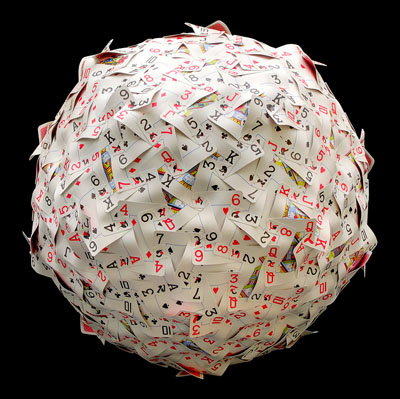
Poker Cards Sphere by Nick Sayers. 270 poker playing cards slotted together (exactly five packs of cards including the jokers). Inspired by Holger Strøm’s IQ light system. See more of Nick’s spherical sculptures on Flickr.
IQlight® copyright © 1973 and 2000 Holger Strøm.
Poker Cards Sphere copyright © 2011 all rights reserved by Nick Sayers.
Friday, 11 November 2011
The Four Horsemen of the Apocalypse
Three clips from the silent film The Four Horsemen of the Apocalypse, 1921, directed by Rex Ingram.
A short account of the plot, from Liam O’Leary’s excellent book, Rex Ingram, master of the silent cinema:
Julio was of course played by Rudolph Valentino in his first major role. The part of Marguerite Laurier was taken by Alice Terry, who later married Rex Ingram. Julio’s father was Joseph Swickard, and the injured husband was John Sainpolis.
Rex Ingram was born in Dublin in 1893, and went to the US in 1911. He studied sculpture, turned to acting and writing, and directed his first film aged 23. After achieving success in Hollywood, he eventually relocated to Nice where he had his own film studio, and where a young Michael Powell worked as his assistant.
Below, a sketch by Ingram for The Four Horsemen of the Apocalypse, along with photographs from the production, all taken from Liam O’Leary’s book.


Above: Alice Terry and Rudolph Valentino rehearse the tango.
Below: Rex Ingram instructs Valentino.


A short account of the plot, from Liam O’Leary’s excellent book, Rex Ingram, master of the silent cinema:
The story of The Four Horsemen began in the Argentine and told of the return of two branches of a wealthy family to Europe, one to Germany and the other to France. The pleasure-loving central character seduces the wife of one of his father’s friends but eventually fights for France when the war comes. His German cousins are fighting on the other side. The erring wife returns to her husband, now blinded by the war. Julio, the hero, is killed.
Julio was of course played by Rudolph Valentino in his first major role. The part of Marguerite Laurier was taken by Alice Terry, who later married Rex Ingram. Julio’s father was Joseph Swickard, and the injured husband was John Sainpolis.
Rex Ingram was born in Dublin in 1893, and went to the US in 1911. He studied sculpture, turned to acting and writing, and directed his first film aged 23. After achieving success in Hollywood, he eventually relocated to Nice where he had his own film studio, and where a young Michael Powell worked as his assistant.
Below, a sketch by Ingram for The Four Horsemen of the Apocalypse, along with photographs from the production, all taken from Liam O’Leary’s book.


Above: Alice Terry and Rudolph Valentino rehearse the tango.
Below: Rex Ingram instructs Valentino.


Wednesday, 31 August 2011
Big bone

My friend Philip Moss is showing some of his paintings next month at The Glebe Gallery, Churchill, Co. Donegal, from the 4th of September ’til the 2nd of October. The one above is titled Big Bone (for SS).
Subscribe to:
Posts (Atom)


